
Think of the last time you walked toward a meeting you knew would be hard. Moments before the door opened, something happened in your body: a slight tightening in the jaw, heat rising in the chest, a breath that ran a little short. You hadn't said a word yet, and you hadn't heard one — and still, your body had already read the room and sent you a first signal.
That bodily signal is where everything begins. What you do with it in the next few seconds decides what kind of leader you are in that moment.
Because a leader meets complexity, conflict, and change, again and again, as a moment of doom. The reason is quiet and understandable: the world around you never stops shifting, faster than any plan can keep pace with — the moment you finish picturing it, the ground has already moved past your picture. And the body feels that gap before the mind can name it. Facing it, you have three ways to respond: deny that anything has changed, fight and demand that the world change, or be present.
These three are not ideas you choose with the mind; they are muscle memory, firing under pressure before you notice. I've watched them recur in leaders, and in myself:
The first: the Denial perspective — "Nothing needs to change." The leader holds to the usual ways, listens selectively to whatever validates them, keeps an eye fixed on the goal, and avoids confrontation by delegating it away so as not to feel responsible. This is the Denial response.
The second: the Fight perspective — "Others need to change." The leader wants to stop the present or reverse it, sets out to "wake up" those in denial, driven by a can-do drive and a high sense of justice that feeds on confrontation, telling people what to do to halt the doom curve. This is the Fight response.
Denial and Fight are not the enemy; they are the untrained response — the one that springs from Exploity, the future-self racing toward what's next, or from Mr Control, the past-self clinging to what came before. But they share one thing: both lead from a map drawn in advance. Denial reads the map of the past — what worked before. Fight reads the map of the future — what should happen. Both look at the paper, not at the ground.
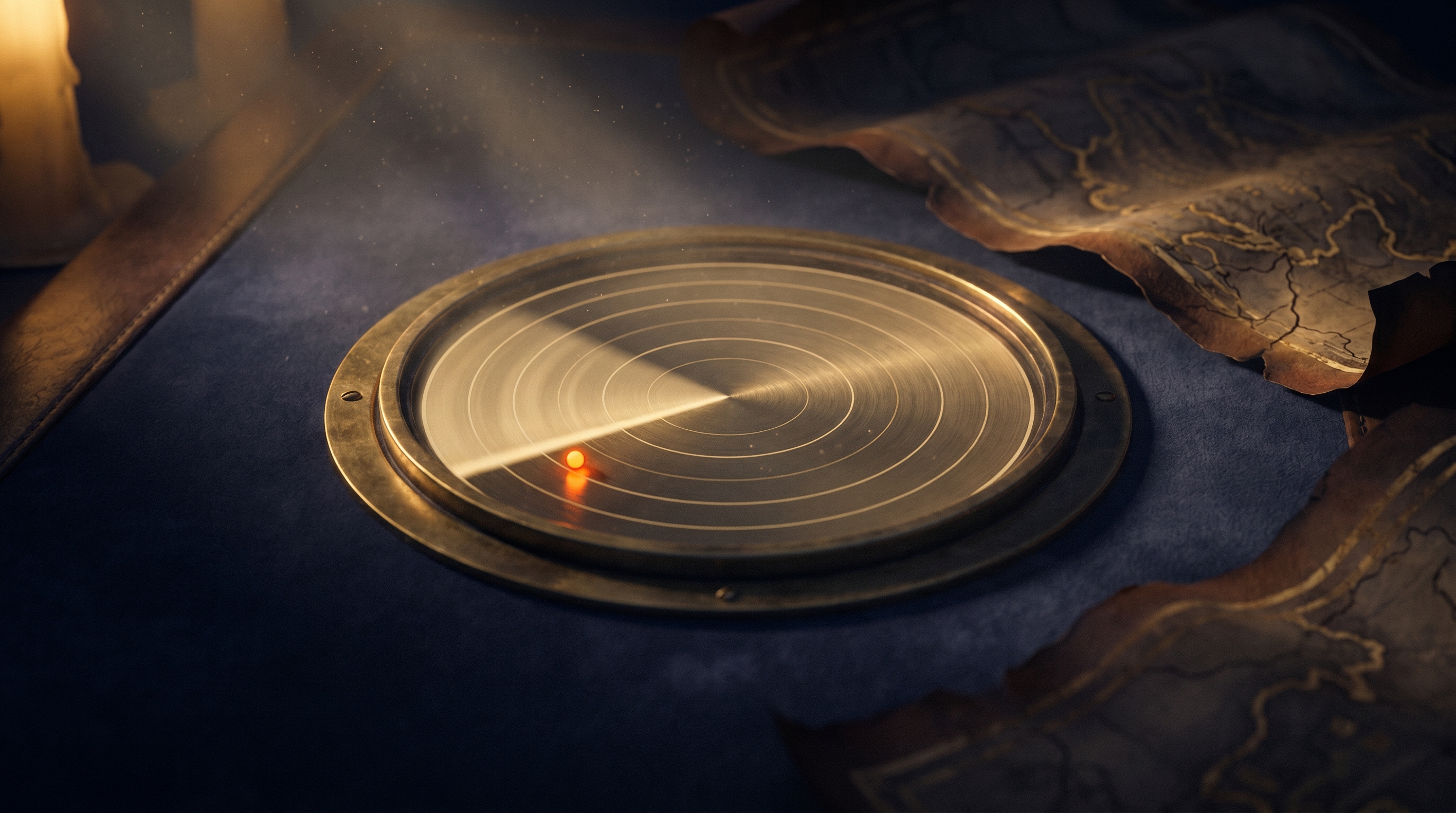
So picture two leaders. The first is a cartographer: they enter with a map perfected before they arrived, and read every room by its light. When the ground differs from the chart — and it always does — they trust the paper over what is beneath their feet, and move out of sync with the place and the moment, leading a modified copy of reality rather than reality itself. The second is a radar: carrying no drawn map, but a live instrument that receives what is actually there, now, in this particular room. Radar does not assume; it receives. It does not dictate to the place how it ought to be; it senses it as it is.
This is the third way — the Presence perspective — and it is the muscle that must be trained until it fires under pressure in place of the doom reflex: to be the radar. It does not mean gripping the situation more tightly; it means receiving more sensory information through the body so that Grandma Wise — who embodies presence because she listens to the body before she listens to the mind — comes forward and leads. When she does, the mind is freed from the noise of past and future, from the attachment to knowing, and from the urge to control what cannot be controlled. And you cross the unknown effortlessly, with spontaneous responsiveness — a live answer that comes from the ground, not from the paper.
And you already know this difference in your body. How often have you walked into a place and sensed something had shifted before anyone spoke? How often have you sensed a decision was "off" — a weight in the chest — before you had words to explain why? Your body reads the field faster than your deliberate thought. And the faculty doing that receiving is not a rare gift handed to a few; it is Hyper Sensory Perception «الإرهاف الحسّي» — an innate capacity in you, sharpened by presence. The Radar Leader is not someone in whom we installed a new sense; it is someone trained to trust a sense that was with them all along, and to make it the source of how they lead.
And this radar isn't new to you. It is the same radar I described in a coach sitting with a client — "a strong radar inside," that turns toward whatever draws its attention and explores it. The difference is that now you carry it into the boardroom, into the crisis, into the conversation you'd been avoiding. And when it reads the field, it doesn't read it all at once. As you saw in the Perceptual Spheres, presence has somewhere to go: the radar turns first inward — what is moving in you before you speak; then to the person before you — their tone, their posture, what lies beneath their words; then to the place itself — the ease or the contraction filling the room. One sphere at a time, the radar sweeps the field rather than reading it off a chart.
Here is a place I'll touch gently, because for me it is the heart of it. The cartographer clings to the map because of a wish to secure the unknown — to seize it and pin it down. The radar lets it go. In my faith, this is striving in its truest form: we take the means with everything we have — we show up, we receive, we read the ground as honestly as we can — and then we entrust what lies beyond it to the One who alone holds its keys. The leader who believes they must keep an iron grip on every unknown is the leader who never stops drawing charts; afraid to let the chart go, because they take it for all they have. But once they know their striving is their duty while the unfolding is not theirs alone to govern, the grip loosens — and when the grip loosens, the radar works. Presence, somewhere in this, is close kin to reverence: being fully here for what is in your hands, having surrendered what is not.
And if you don't share that faith, the door is open to you all the same: the benefit of this kind of leadership lives in the practice, not in the explanation you choose to place on it.
And notice what none of this says. I am not dictating your decision. You are the wisest person in your own world and your own organization; I haven't lived a day in either. The Radar Leader doesn't promise to tell you what to do; it promises that the field will come back to you clearer, so you see what you weren't seeing — and the decision stays yours. The clarity is ours to offer; the act is yours.
For today, this is enough: when a hard moment crosses your path — a charged meeting, a clash between two teams, a change you didn't choose — don't reach first for your map. Return to that first signal in your body, and let Grandma Wise look first. Be the radar, not the cartographer.
When you're ready, the door is open.
Where to next?
- Read on: What Makes Somatic Thinking Different →
- Back to the root: What a Somatic Thinking Session Is Really Like — where the same radar works →
- Experience it: book a session →
- Become the coach: Somatic Thinking Coaching Education (STCE) →
Somatic Thinking was created by Samer Hassan and first set down in Coaching Presence (Dr. Tünde Erdős, Open University Press / McGraw-Hill, 2021) — a book built on Dr. Erdős's pioneering doctoral research into coaching presence.