
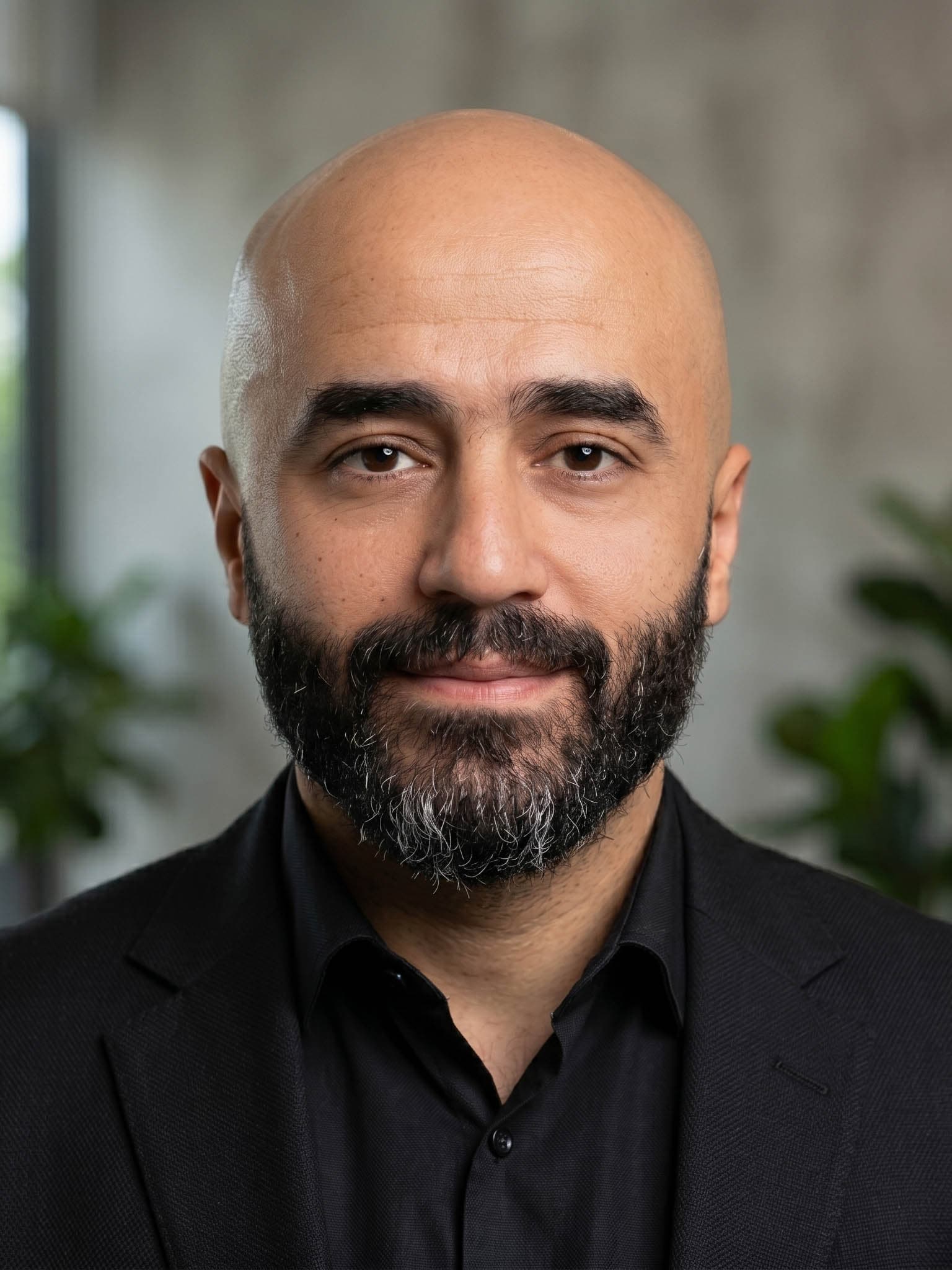

This reader arrives with a face I know well. Not arrogant — trained. They've read the literature, sat through the conferences, and can tell a sturdy idea from a decorated one in a single breath. They listen politely, then say the honest thing they're thinking: "Everything you're describing, I've read somewhere already. The body shapes the mind — that's embodied cognition. Returning to sensation — that's interoception. Widening circles of attention — I've seen those in Theory U. There is nothing new here. An elegant synthesis, fine; but old wine in a new bottle."
I respect that objection, and I don't run from it. I respect it more, not less, when it comes without contempt — because this isn't hostility to the idea; it's intellectual honesty, and it's exactly the kind of scrutiny I want what I teach to stand on. So let me, in this one piece, not silence the objection but honor it: concede the kinship in full, then show you where the difference actually stands, on ground that holds. And let me ask us to agree on one thing at the outset, because the whole argument turns on it: for an applied methodology, the test of newness is not "a mechanism no one ever described." That's a flag almost no one can honestly raise in a mature field. The truer test is a different question — does the integration do work that no prior framework does?
First, one word I have to correct, because it recurs whenever someone likens Somatic Thinking to its neighbors. What some people call "energy," I name precisely: a bodily sensory signal — something your body receives and your self gives meaning to, not a vague force moving through the air. I don't correct this to embarrass anyone; if "energy" is your language, it's yours, and that's okay. I correct it because precision in naming is the first thing that distinguishes the work I do.
So let me begin by conceding, not defending. The reader is right, and more right than they think. And I won't concede vaguely; I'll name the fields they know, by name, because the academic reader respects sourcing. That the body shapes the mind: that's the working claim of embodied cognition, with its own lineage. That perception is the brain's best guess, continuously checked against what the senses report: that's the heart of predictive processing, and some researchers call its perceptual face a controlled hallucination. That attention widens from self to other to environment: a map already drawn in Theory U and in integral theory. That time — past, present, future — keeps a grip on how we sense the present moment: an entire research field, time-perspective psychology, working that ground decades before me. That presence can be trained rather than waited for: said in coaching before I wrote a word. I hide none of it. The reader is right.
Now, having handed them every piece separately, let me ask the question that moves this whole piece: if science describes all of it, what is left for me?
Let me answer with an image you'll keep. Picture a living language, spoken every day by ordinary people. A brilliant grammarian comes and catalogues all its rules: when a verb takes which ending, how a clause is built, where the stress falls. They hand you a precise, rigorous map of the language. That is fine and necessary work. But the map is not the language. The child at home speaks it fluently and has never read a single rule; the grammarian may know every rule and still not hold a living conversation in it. To describe a grammar is one thing. To speak the language, in real time, is another thing entirely.
That is the difference, as exactly as I know how to say it. Science describes the mechanism — and it describes it beautifully; I hold that work in real respect. Somatic Thinking does not contest the description; it gives you what the description alone cannot: a way to catch the moment as it happens, through the body, not through an idea about the body. To know that your perception is "a guess being revised" is a precious knowing — it changes how you see. But it does not catch the guess as it slips in a tense meeting on a heavy afternoon. Somatic Thinking is built to catch it — not merely to understand it, but to train you to catch it with your body, in the moment. This is not an idea loftier than the science; it is work of a different kind: not describing the mechanism, but training you to ride it.
And here is a distinction I won't let pass quietly, because the trained reader knows its worth. I am not saying that science "proves" Somatic Thinking. Two roads meeting is not one proving the other. Think of it as two instruments sighting the same point from different angles — neither touching the other, each fixing it from its own position. When they agree, the point is firmer; but no instrument becomes "evidence" of the other. I sighted it from the body, and science sighted the same point from its own angle. The most honest thing to call that is what it is: a convergence, a meeting — not a validation. If I claimed the science endorsed my work, you'd have every right to answer, "Then you're borrowing its authority." No. The kinship is striking, and it's enough that it's striking. The one who lets convergence stay convergence, and never inflates it into proof, is the only one who's earned the right to be taken seriously.
And this convergence does not stop at today's laboratories; it reaches back further than the reader expects. More than a thousand years ago, Imam Abu Zayd al-Balkhi (d. 934 CE) devoted a book to the wellbeing of the bodies and the selves — and he was, first and foremost, an empirical physician, building on clinical observation, not on a text he was transmitting. Yet he sighted the same point from his own angle: he coined a precise word for the bond of body and self — interlacing (التشبيك) — the very bond today's lab studies under the name embodied cognition; he defined the health of the self as its stillness (سكون النفس), close kin to what I call presence; and he held that the self, like the body, is trained by a regimen — the training of the selves (رياضة الأنفُس) on the model of training the body. I don't raise any of this to prove a theory I'm seeking support for. What I'm sharing is the distillation of years of work with the body and the self — what I have watched work in front of my own eyes thousands of times, with thousands of people. The kinship with al-Balkhi and with the laboratory is a witness that stands alongside this practice and makes it more firmly rooted — not a foundation it rests on, nor an authority it borrows: each meets, from its own angle, what I already came to know through the body, and the meeting is the more beautiful for it. What I made is the way this wisdom is spoken in the moment, through the body, in the session: the rules were mapped centuries before me, and al-Balkhi was among the earliest to map some of them — but the living utterance of them is my work. Somatic Thinking walks with pride on the same path al-Balkhi began, and I give that inheritance its full due in the companion piece.
So where is the newness, if not in any single piece? In three things together, inseparable. The first is the synthesis: gathering what lived scattered — body and mind in one lab, interoception in another, time in a third, attention's circles in a fourth — into one system you can actually walk. The second is the somatic grounding, and it's the weight-bearing one: taking each concept that had been an idea turned over in the head, and re-anchoring it in felt sensation — in the weight that drops onto your chest, the warmth that moves in your hand — as the operative mechanism, not as a theoretical comment laid on top of it. The third is the naming: giving every position in the system a name that makes it learnable, transmissible, trainable — because what has no name cannot be taught. Those three are mine. To borrow the image: the words were always there; the sentence is mine. And to be as precise as the reader likes: I know of no prior model — in somatics, coaching, integral theory, Theory U, or contemplative science — that unites in one practiced system a non-local sphere like the OMNI-Sphere, a distinct bundle of sensation belonging to each sphere alone, and the ability to switch between them in the present moment itself. Nor one that makes the temporal axis — past, present, future — the organizing principle for named, embodied personal states. This particular gathering of them is my contribution; the pieces may not be mine, but assembling them this way I have not found in anyone else's hands.
You'll notice I'm not resting any of this on a word I coined. The trained reader might press: who's to say no one used that phrase before you? It's a fair question, and my answer is that I don't hang the claim on lexical priority at all. I'm not saying I'm the first to utter two words; I'm saying this named, integrated methodology — its synthesis, its somatic grounding, its nomenclature — I know of no counterpart that assembles it the way it's assembled here. The claim is on the building, not the label. Hang your originality on a word and you hand your weapon to the first person who finds that word on an old page; hang it on the building, and it holds.
Because the academic reader weighs evidence on a particular scale, it's only fair to show them the ground I stand on. When Somatic Thinking was first set down, it was within Coaching Presence, which rests on a rare piece of doctoral research by Dr. Tünde Erdős: a study analyzing a hundred and eighty-four videoed coach–client pairs. Let me dwell on the kind of evidence, because that's what matters. Most "evidence" in coaching is what people say about themselves — questionnaires, satisfaction scores. A careful reader discounts those; they're hostage to what a person likes to report. The synchrony measure in this study is of another kind: an analysis of the movement of bodies on film, tracking their attunement directly — a behavioral signal, not a self-report. Independent researchers, measuring bodies on tape, found the very attunement signal that Somatic Thinking's methods are deliberately built to cultivate. And I want to name this for exactly what it is: convergent evidence that meets my work, not a controlled trial proving Somatic Thinking is the cause. I won't make the study carry what it can't. The work contributes the "how" to that research's "what": those studies show that presence and nonverbal attunement matter to outcome; Somatic Thinking is a trainable way to produce that attunement on purpose.
Let me clear up one confusion I know occurs to the careful reader. When I describe the farthest sphere — the OMNI-Sphere, where sensation reaches across distance — and borrow from physics the image of two entangled particles that stay correlated however far apart they are, I am borrowing an image, not claiming a physics. Let me keep two things cleanly apart. When two people sit in the same room, their nervous systems fall into an observable attunement you could measure on video — that is entanglement in the relational sense: a correlation, not a signal crossing the gap, not information passing between people. The OMNI-Sphere goes further than what film can capture; and there I claim no measurement at all, only a sensory reception of a state that already is, then verified — not premonition, not a claim on the unseen. I keep this scientifically weakest edge clearly fenced off from the sturdy core, so that no one can pull down a whole method by its frailest joint.
And here I'll say what I believe, without decoration and without hiding it. I see in this connectedness a sign of a Creator who wove existence into a single fabric. In my faith, the keys of the unseen belong to God alone — I dwell on that more fully in The Perceptual Spheres — and what I am describing is not those keys, but a heightened bodily perception — Hyper Sensory Perception «الإرهاف الحسّي» — that catches what is already present. Hyper means the ordinary senses sharpened, not a psychic faculty added. You don't have to share my faith to walk this path or to benefit from it. Whatever frame you bring to understand the world — faith, science, or neither — is yours, and it takes nothing from what the practice gives; because the benefit lives in the sensation your body receives, not in the explanation you place upon it (and there's nothing wrong with placing one, by the way). I promise you no magic formula, no guaranteed cure. Somatic Thinking explains a mechanism, trains you in a method, and returns clarity to you. You do the knowing.
For today, this is enough: when your trained mind says "nothing new here," it is not wrong in half of what it says. The pieces are known, the science keeps circling them, and the kinship is real. The half it misses is the half I wanted you to see: I did not discover the language — the language is there, its rules were mapped before me — but I shaped a way to speak it in real time, through the body, and I gathered and named that way so it can be learned and trained. That is what's new: not a truth no one ever spoke, but a living utterance of what was already written down. And the deepest form of that utterance — to ask your body a question directly and let it answer — has a name — and it is something you step into in a session, not something you read.
When you're ready, the door is open.
Where to next?
- Read on: Somatic Thinking — Reviving the Wisdom of Body and Self →
- Experience it: book a session →
- Become the coach: Somatic Thinking Coaching Education (STCE) →
- Back to the companion: What Makes Somatic Thinking Different →
Somatic Thinking was created by Samer Hassan and first set down in Coaching Presence (Dr. Tünde Erdős, Open University Press / McGraw-Hill, 2021) — a book built on Dr. Erdős's pioneering doctoral research into coaching presence.