

Picture a man standing, suddenly ablaze with anger. The heat climbs in his face, his breath tightens, his hand closes on its own. And before he can even bring his mind to bear on the anger, the Prophetic guidance reaches him with an instruction aimed first at his body. The Prophet, peace be upon him, said: "If one of you becomes angry while standing, let him sit down; if the anger leaves him, well and good — otherwise let him lie down."
Notice the precision of it. Not "suppress your anger" on its own — but change the posture of your body, by degrees: standing, then sitting, then lying down. The more intense the feeling, the more you shift the body's posture; and anger here is but one example of a feeling that takes hold of a person and blinds his reason. This is the cleanest expression I know of a truth I have built my life's work upon: feelings are built upon sensations in the body first, and changing the state of the body changes the state of the self.
When I first began to name what I was working with and shape it into a method, I assumed — as many do — that I was reaching for something out East, or out West. But when I returned to the medical books of our own heritage, I found that what I had arrived at was not entirely new; it was a continuation of what they had said centuries ago. And I became certain that what I was searching for lay neither in the East nor in the West, but in the roots closest to me.
So let me show you those roots — not as history we pass over, but as a living wisdom that belongs to you, one I am reviving, not inventing from nothing.
The First Layer: Roots We Revive
More than a thousand years ago, Imam Abu Zayd al-Balkhi (d. 934 CE) devoted a whole book to the matters of the self, and called it Sustenance of the Bodies and Selves (Masalih al-Abdan wa-l-Anfus). Look at the title alone, for it holds the heart of the matter: the bodies and the selves — not the souls. He set the self — the inner person — alongside the body, and made wellbeing something that completes only when the two are taken together. And this is exactly what Somatic Thinking revives when it makes the partnership one between the body and the self — not between the body and some vague thing severed from it. As for the rūḥ — the spirit — it is of my Lord's command. God, exalted is He, said: They ask you about the spirit. Say: the spirit is of my Lord's command (Qur'an 17:85). It is a secret among secrets we are given no power to delve into; and so Somatic Thinking works with the self, which we can know and train, not with the spirit.
Al-Balkhi did not stop at joining them; he coined a precise word for their bond: interlacing (tashbik). He wrote that God "composed the selves within the bodies in a composition of the utmost soundness and craftsmanship, and laced them together with a lacing than which none could be stronger or more complete." A self and a body woven into one integrated whole. And here I want to give the learned editor Malik Badri his due: he reads in this a foreshadowing of what the West later called psychosomatic, and of what modern science calls embodied cognition — and I am relaying his reading, not advancing it as settled history.
Al-Balkhi defined the health of the self as its stillness: "that its faculties be at rest, and that none of the psychic disturbances agitate it." For him, health was not the absence of events, but a tended, present state — and that is very close kin to what we call, in Somatic Thinking, presence. On this he built his entire project: a training of the selves modeled on the training of the bodies — the idea that the self has ailments to be treated just as the body's ailments are treated. As he put it in his book: "Just as the body has ailments treated with medicines, so the self has ailments treated with discipline and training." Psychic states, in his understanding, are tended and trained — not merely endured. And this very principle — that the self is trained as the body is trained — is what makes Somatic Thinking a method one trains in, not an idea one contemplates.
And when he came to anger, his words drew about as close as words can to the Prophetic guidance in their meaning. He gave it a chapter of its own, because — as he saw it — it is the most frequent thing to befall a person and the most repeatedly harmful. He described it, in the medical idiom of his age, as a bodily event before anything else: the body is thrown into disorder, the color changes, the person is cast into agitated movements until the body is heated "with a heating that follows upon fever." And that bodily disturbance is, in the language of Somatic Thinking, the felt bodily signal the coach reads in the moment. And because anger lodges in the body, he advised reaching it through the body rather than through resolve alone: he advised catching it at the first stirring before it bolts away with the person like a horse; calming the body's agitation and waiting for the heat to subside before any judgment or act; and turning the gaze away from whoever caused the anger, because looking reignites it.
And here I pause to be completely honest with you, because it is this very honesty that lets the claim withstand any critic: al-Balkhi does not cite the Hadith of anger. He built his regimen on medical observation and experience, not on a Prophetic text he was transmitting; rather, drawing the two together is my own ijtihad — my own considered reasoning and reflection. So what binds the two together, then? They meet at the same truth. The Prophetic guidance commands a change of posture (standing → sitting → lying down) to bring the anger down; al-Balkhi describes — in the physician's independent language — how the feeling settles when the body settles. Somatic Thinking stands precisely where Prophetic guidance and al-Balkhi's medicine meet at a single meaning. I never say that al-Balkhi cited the Hadith; I say the two converged — and that is the more truthful thing to say.
Nor was al-Balkhi alone in this field. He stands within a wider current of the scholars of our golden age who made the tending of the self a science: Abu Bakr al-Razi in Spiritual Medicine (al-Tibb al-Ruhani) — that is the literal title of a book from our heritage, not a term I adopt — who devoted a whole work to treating the ailments of the self by reason and discipline — from mastering desire, to restraining anger, to dispelling grief and sorrow. And Ibn Sina (Avicenna) in The Canon of Medicine, when he tied balanced movement and exercise to the body's wellbeing and its link to the self. And in the wider horizon — the horizon of cultivating and purifying the self — Abu Hamid al-Ghazali in The Revival of the Religious Sciences (Ihya' 'Ulum al-Din); and I can't help noting here that the word Revival (Ihya') in his title is close kin to the "reviving" I am writing about in this very piece — for he, may God have mercy on him, revived the religious sciences, and I am trying, to the measure of my ability, to revive the wisdom of the bodies and selves. And Abu Yusuf al-Kindi in The Art of Dispelling Sorrows, in his cognitive treatment of grief. I name these as the wider current for tending the self in our heritage — not as one being a source for another.
The Second Layer: Science We Reframe
Now look at what the modern laboratories are doing, and you'll find them returning to the same room. What al-Balkhi called the "interlacing" of body and self has become, in contemporary science, embodied cognition — the finding that the body shapes the mind, not only the other way around. What he described — the self catching what arrives upon it — is studied today under the name interoception. Even presence-as-alignment-with-reality has its echo in science: that your brain, in every moment, forms the truest guess it can about what's around you, then corrects it against what you feel in your body. And his turning of attention toward past, present, and future has become a pivot in time-perspective psychology. These are touches, no more; the full scientific rigor belongs to other pieces in this series.
And let me be as candid in this layer as I was in the first: not every idea in this science is born of our day, and not every one of my own ideas is without precedent. The notion of giving inner states a body and a character — of giving them faces and names — has precedents in various psychological traditions. This honesty is deliberate on my part; I make no claim to have discovered what did not exist. Rather, I re-read these truths, reframe them, and re-ground them in the body.
The Third Layer: What Is Genuinely Mine
So where do I stand in all of this? My place is in the integration, the re-grounding in the body, the naming, and the making of all this trainable for today's coach.
Mine: Somatic Thinking as an original method in coaching and a philosophy for living, fusing the partnership of body and self with a sensory re-patterning drawn from the martial arts. Mine: the four Perceptual Spheres — perception of the self, perception of the other, perception of the surroundings, and the OMNI-Sphere — as one system you move between. Mine: Hyper Sensory Perception as the innate, God-given capacity placed in the body to receive subtle signals — a heightening of the senses, not a knowledge of the unseen, for the keys of the unseen belong to God alone — and my reading of the OMNI-Sphere as a reading of faith. Mine: the three Experience Shapers by their names — Exploity (in Arabic «حركات», roughly "the schemer of restless maneuvers"), who lives in the future; Mr Control («أستاذ تحكّم»), who lives in the past; and Grandma Wise («جدتي حكيمة»), fully present, who embodies presence itself. Mine: the Butterfly Experience, presence by design, and the four steps into presence.
And here my true signature shows itself: to take an old, true thing — that emotion is read and tended through the body — and re-ground it, not as a counsel to be recited, but as a felt, bodily signal a coach reads in the moment itself and works with; then to name it, and make it a method one can learn and practice. Not that al-Balkhi is Somatic Thinking — far from it; rather, Somatic Thinking stands in his lineage: reviving what he rooted, and adding to it the bodily grounding, the naming, and the training.
Where This Meets Faith
And there is a deeper layer here that is my own contribution, not al-Balkhi's — for he, may God have mercy on him, was first and foremost an empirical physician, who rarely reached for the unseen in his method. The faith framework of Somatic Thinking is mine, completing what he rooted. Its foundation is that the human being was created from clay and a divine breath; so the self that is interlaced with the body is a subtle, God-given self, not a purely material thing. And for that reason, the stillness of this self completes only when it connects to its source. God, exalted is He, said: Truly, in the remembrance of God do hearts find rest (Qur'an 13:28). The tranquility al-Balkhi describes in the physician's voice, the Qur'an describes by its source: the remembrance of God.
And there is something far wider where this heritage meets faith — and where it parts ways with energy-work and the law of attraction. The cosmos, in the monotheist's vision, is not random vibrations you raise and lower, but a closely-knit edifice in which everything glorifies the praise of its Maker. God, exalted is He, said: There is not a thing but glorifies His praise, yet you do not understand their glorification (Qur'an 17:44). So you are not the source; you are a listener, drawing near, naming the One from whom all of this flows — attunement, not control. And what some call "the qi" or "the energy" is not, for us, an unknown force to be summoned, but a heightening of perception in a body God created to be a listener. This is the heart of my book From Balance to Baraka, and a piece on it is coming.
So, What Is Somatic Thinking?
It is a revival. A wisdom in the partnership of body and self — rooted by Prophetic guidance, given its medical form by al-Balkhi a thousand years ago — that returns to you what is yours by inheritance; for I am not installing anything in you, I am waking what was in you all along. What I do: I re-ground this wisdom in the body, integrate it, name it, and make it trainable for today's coach.
And what sets the heart at ease is that the roots of this understanding are no stranger to our own heritage; it is a wisdom from the wisdom of body and self — one we return to and revive. My Lord, make us among those who listen and so understand, and who know Your grace in their bodies and their selves, and so give thanks.
When you're ready, the door is open.
Where to next?
- Read on: What Makes Somatic Thinking Different — where you'll find the scientific half of the originality story →
- And read also: The Contemporary Murabbi — when the coach becomes the revival of an ancient craft →
- For the academic mind: "Nothing new here"? Somatic Thinking to the Academic Mind →
- Back to the spheres: The Perceptual Spheres — where you move between the four worlds of sensation →
- Experience it: book a session →
- Become the coach: Somatic Thinking Coaching Education (STCE) →
Hadith sourcing: "If one of you becomes angry while standing, let him sit down; if the anger leaves him, well and good — otherwise let him lie down." Narrated by Abu Dharr al-Ghifari (may God be pleased with him); recorded by Abu Dawud in his Sunan (Sahih Abi Dawud, no. 4782; graded sahih / authentic by al-Albani), and by Ahmad in his Musnad (no. 21386).
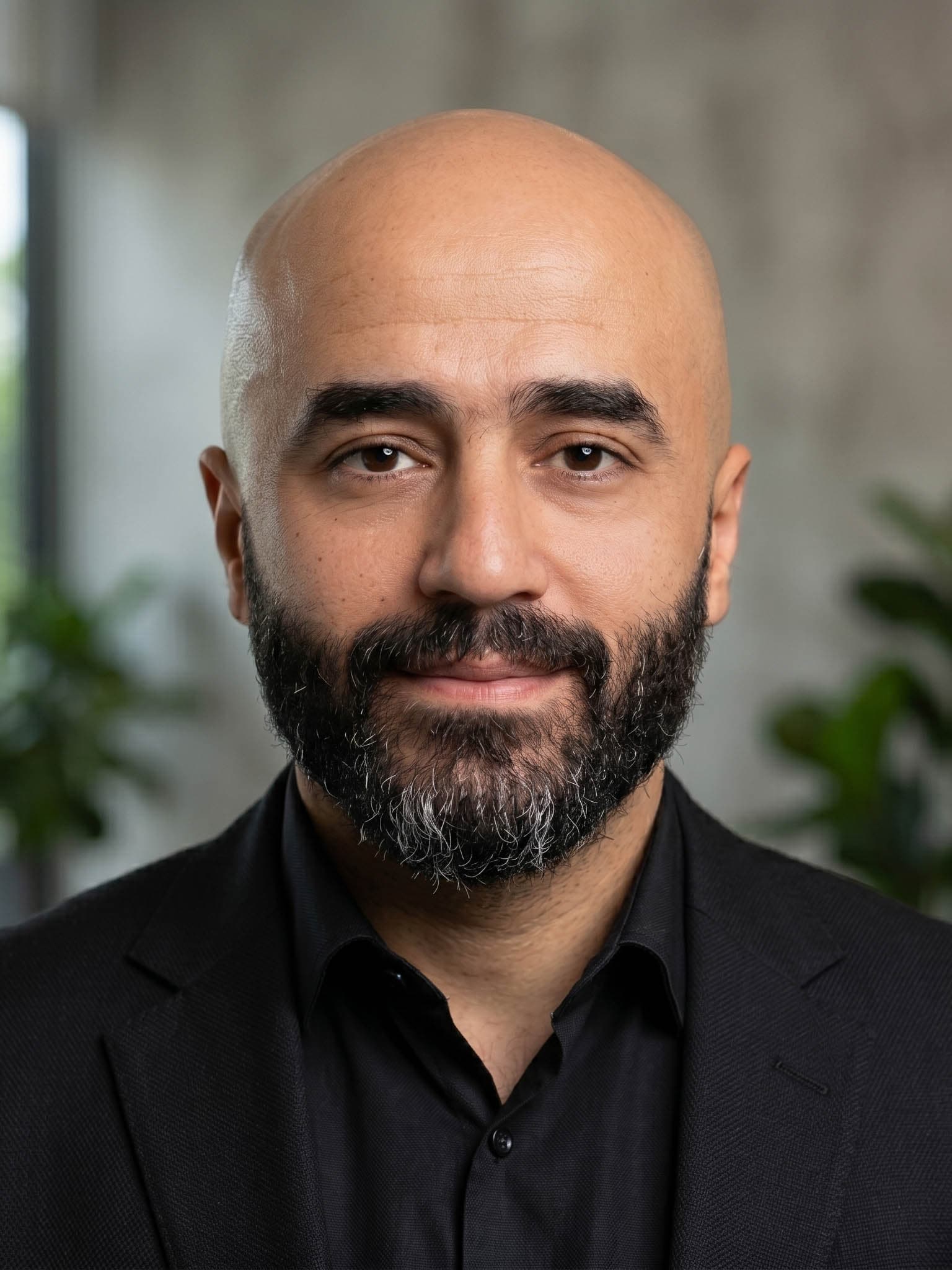
Somatic Thinking was created by Samer Hassan and first set down in Coaching Presence (Dr. Tünde Erdős, Open University Press / McGraw-Hill, 2021) — a book built on Dr. Erdős's pioneering doctoral research into coaching presence.